
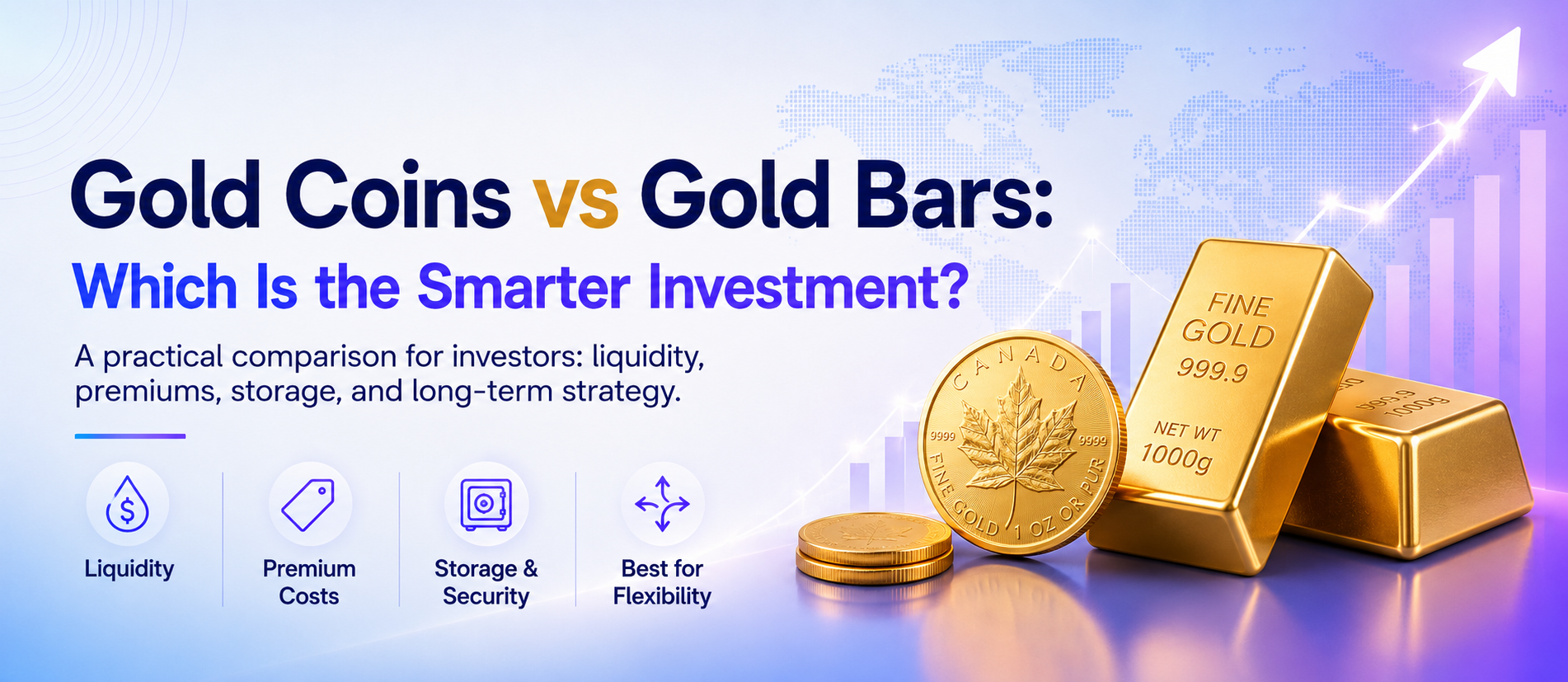
Gold Coins vs Gold Bars: Which Is the Smarter Investment?
Same Metal, Very Different Investment
Gold is gold — whether it's shaped into a coin or pressed into a bar, the underlying metal is the same. So why does the format matter?
Because when you buy gold, you're not just buying the metal. You're also paying for fabrication, brand recognition, and in some cases, collectible value. And when you sell, those same factors determine how much you actually get back.
This guide cuts through the confusion and helps you decide which format makes more sense for your situation.
The Basic Difference
Gold coins are minted by government authorities — think the American Gold Eagle, Canadian Maple Leaf, South African Krugerrand, or Austrian Philharmonic. They come in standard sizes (1 oz, 1/2 oz, 1/4 oz, 1/10 oz) and carry a face value, though their actual worth is tied to the gold spot price.
Gold bars (also called gold bullion bars) are produced by private refineries or government mints in a wider range of sizes — from 1 gram all the way up to 400 oz. They're simpler products: no design, no collector appeal, just refined gold.
Both are real gold. The difference is in what you pay beyond the metal itself.
The Premium: What You're Really Paying
When you buy either product, you pay a premium over spot price — the extra cost above the raw gold value. This covers fabrication, distribution, and dealer profit.
Gold coins carry higher premiums, typically 3–8% over spot for popular sovereign coins. Some coins carry even higher premiums due to collectible demand or limited mintage.
Gold bars generally carry lower premiums — often 1–3% for larger bars. The bigger the bar, the lower the premium per ounce. A 1 oz bar will cost less above spot than a 1 oz coin of equivalent gold content.
What this means practically: if you're buying purely for investment and plan to hold for the long term, bars are usually the more cost-efficient entry point.
Liquidity: How Easy Is It to Sell?
This is where coins have a clear advantage.
Gold coins from major sovereign mints are recognized worldwide. An American Eagle or Maple Leaf can be sold to almost any dealer, bank, or private buyer globally without question. Their authenticity is easy to verify, and demand is consistent.
Gold bars are also liquid, but with caveats. Smaller bars (1–10 oz) sell easily. Larger bars (100 oz, 400 oz) are primarily traded between institutions and are harder for retail investors to offload quickly. Unknown or lesser-known refineries may attract lower offers or additional scrutiny.
If you ever need to sell quickly or in an unfamiliar market, coins give you more flexibility.
Storage and Security
The larger your gold holding, the more storage matters.
Gold bars are more space-efficient. A 1 kg bar takes up far less room than the equivalent weight in coins. For serious investors storing large quantities, bars are easier to stack, vault, and insure.
Gold coins take up more space and are harder to store neatly in bulk. However, for smaller holdings, this rarely matters — a few coins fit easily in a home safe or safety deposit box.
Insurance costs are typically based on value, not format, so that's less of a differentiator.
Counterfeiting Risk
Both coins and bars can be counterfeited, but the risk profile differs.
Sovereign coins benefit from intricate designs, security features, and global recognition — making fakes easier to spot and less common in reputable markets. Most major dealers use electronic verification tools.
Gold bars — especially from lesser-known refineries — can be harder to authenticate, particularly for private buyers. Tungsten-filled bars have appeared in circulation over the years, though this is rare with reputable brands. Sticking to LBMA-accredited refineries (Valcambi, PAMP, Heraeus, etc.) significantly reduces this risk.
Tax Considerations
In many countries, gold coins from sovereign mints receive favorable tax treatment.
In the UK, for example, British gold coins (Sovereigns, Britannias) are exempt from Capital Gains Tax. In the EU, investment gold — both coins and bars meeting certain purity standards — is exempt from VAT. In the US, both are subject to capital gains tax, but reporting thresholds differ.
Always check the rules in your country before buying. In some cases, the tax advantage of coins can outweigh their higher premium.
Which Should You Choose?
Choose gold coins if:
- You're a first-time buyer or investing a smaller amount
- You value flexibility and ease of resale
- You want globally recognized, easy-to-authenticate gold
- Tax advantages apply in your country
Choose gold bars if:
- You're making a larger investment and want to minimize premiums
- You have secure storage arranged
- You're buying from a reputable, LBMA-accredited refinery
- Long-term holding is your strategy and liquidity is less of a concern
The balanced approach: Many investors hold both. Coins for flexibility and smaller transactions, bars for cost-efficient bulk storage of value. This combination gives you the best of both worlds.
Frequently Asked Questions
Are gold coins or bars a better investment? Neither is universally better — it depends on your goals. Bars offer lower premiums for large purchases; coins offer better liquidity and global recognition.
Can I sell gold bars anywhere in the world? Major branded bars from LBMA-accredited refineries are accepted globally. Obscure brands may face more scrutiny or lower offers.
Do gold coins have collectible value beyond their gold content? Some do — particularly rare or limited mintage coins. But for investment purposes, stick to standard bullion coins where value tracks the gold price closely.
How much gold should a beginner buy? There's no universal answer. Many advisors suggest starting with 5–10% of your portfolio in precious metals. Buy what you can store securely and won't need to sell in a hurry.
Where is the safest place to buy gold? Reputable dealers, government mints, and established banks. Always verify credentials and avoid deals that seem too good to be true.
Bottom Line
Gold coins or gold bars — both are legitimate, time-tested ways to own physical gold. The right choice comes down to three things: how much you're buying, how easily you want to sell, and whether tax rules favor one format in your country.
For most first-time investors, a recognized sovereign coin is the simplest and most flexible starting point. As your holdings grow, adding bars becomes increasingly cost-efficient.
Either way, owning physical gold remains one of the most reliable ways to preserve wealth across economic cycles — regardless of the format it comes in